Phantom Crypto Wallet Features, Security, and How It Compares
What Phantom Crypto Actually Is
Phantom crypto is a non-custodial wallet that started on Solana and expanded to Ethereum, Polygon, Bitcoin, and Base. A March 10, 2025 feature overview described it as one of the entities moving to the top of the crypto value stack because it controls a direct user relationship and the flow of transactions. By February 19, 2026, Phantom had 15 million monthly active users and was still growing.
If you want a an app that holds your crypto handling trading, spending, and storage in one place, Phantom crypto tries to do all of it. You store tokens, swap assets, stake SOL, manage NFTs, connect to dApps, trade perps, and spend via a debit card or Phantom Cash. The core idea is simple: you keep control, and Phantom just provides the interface.
"Phantom became a wallet used by millions of people" - Spencer Bogart, Jonah Burian, February 2026
Full Phantom Setup Walkthrough From Scratch
How Phantom Crypto Controls Your Assets
Crypto wallets do not hold coins the way a bank holds dollars. Phantom crypto manages cryptographic keys that control blockchain addresses where your assets are recorded. The public key works as your wallet address - share it to receive funds. The private key grants authority over those assets and must stay confidential. Lose the private key and you lose access permanently, unless you have a recovery method.
When you send tokens, swap assets, stake, or connect to a dApp, the transaction gets signed with your private key. That signature proves ownership and authorizes the transfer. The transaction then broadcasts to the blockchain for validation. One Phantom overview describes tokens added to the wallet as "securely stored" on your device. The wallet encrypts the private key locally and it does not leave your device under the described security model.
Crypto wallets don't hold crypto. They hold keys. The assets stay on the blockchain.
Core Wallet Features in Phantom Crypto
Phantom crypto supports receiving tokens - you select the asset, copy the address, or scan a QR code. Sending works the same way: pick the token, enter the recipient, choose the network, specify the amount, review, and confirm.
The in-wallet swap lets you exchange one cryptocurrency for another without leaving the app. A March 10, 2025 overview reported a swap fee of 0.85% plus network gas fees, though the fee may vary with volume. You can also buy crypto through third-party providers using various payment methods, all while keeping self-custody.
Staking SOL earns rewards. NFT management lets you display and organize collections - Phantom's Solana roots made it a natural fit for Solana NFTs. dApp connectivity turns the wallet into a gateway for DeFi, NFT marketplaces, lending, minting, and other blockchain services.
Core features at a glance
- Receiving and sending tokens across multiple networks
- In-wallet token swaps with adjustable slippage
- SOL staking for rewards
- NFT viewing and organization
- dApp connectivity for DeFi and Web3
- Perpetual futures trading
- Phantom Cash for spending and bank funding
Phantom Perps and Perpetual Futures
Femi Awomosu, Senior Product Manager, announced Phantom Perps on July 8, 2025. The product aimed to make perpetual-futures markets accessible through a mobile-first interface for both beginners and experienced traders. Perpetual contracts let you take a position based on expected future price without owning the underlying token. Unlike traditional futures, there is no expiration date.
Perps support several strategies. Speculation lets you bet on price movements without buying the asset. Short positions let you profit from declines - something spot trading cannot do. Leverage lets you control a larger position with less capital, magnifying both gains and losses. Hedging lets you offset potential spot losses with a short position.
The launch highlighted more than 100 perpetual-futures markets, including BTC, SOL, ETH, PEPE, FARTCOIN, and DOGE. Positions open, close, and manage from the Home tab alongside tokens and collectibles. The interface includes long and short selection, position-size controls, a leverage slider, stop-loss, take-profit, and real-time alerts.
Phantom Perps runs on Hyperliquid. Funding takes less than a minute - you fund with SOL, which converts to USDC on Hyperliquid automatically. The source says the announcement was not intended for UK audiences, and Perps are not available everywhere.
Perps Risks You Should Understand
Leverage magnifies losses. A smaller capital base controls a larger position, so market moves against you can wipe you out fast. Liquidation happens when your position gets forcibly closed because the market moved too far. Higher leverage raises the liquidation risk.
Funding rates keep perpetual prices aligned with spot prices. Hold a position long enough and you may pay funding fees, which eats into returns - worse with higher leverage. The source warns: start small, don't use more leverage than you can afford to lose, and set a stop loss.
Perpetual futures are powerful but carry significant risk. The stop-loss feature helps prevent liquidation and protect capital.
A May 28, 2026 update let users fund perps directly from Phantom Cash Balance, avoiding a separate transfer or swap. The update also invited feature requests and repeated that Perps are not available everywhere and carry significant risk.
Phantom Cash and Everyday Spending
Seyi Taylor, Cash Product Manager, introduced Phantom Cash on September 30, 2025. The idea: use crypto for everyday spending without moving funds to another service first. Phantom Cash aggregates on-chain and off-chain money and adds tools for spending, receiving payments, and accessing virtual or physical cards.
The six components include instant bank funding, quick crypto-to-cash conversion, peer-to-peer payments via username, a Phantom Debit Card usable anywhere Visa is accepted, a virtual account with direct deposits, and rewards on eligible CASH balances. CASH is a fully backed, U.S. dollar-pegged stablecoin on Solana designed for everyday use.
KYC is not required for on-chain features but is required for virtual accounts, direct deposits, and the debit card. Stripe handles KYC, and Phantom says it does not receive personal information for that process. The card is issued by Lead Bank under Visa licensing. Bridge Ventures LLC operates the program but is not a bank. Phantom is not a bank either - it is a financial-technology company.
Phantom Cash features
- Instant bank or card funding
- Crypto-to-cash conversion in a few taps
- Peer-to-peer payments via Phantom username
- Debit card usable with Visa, Apple Pay, Google Pay
- Virtual account with direct deposits
- Rewards on unspent CASH balances
A-to-Z Phantom Guide With Security Tips
Security and Self-Custody Model
The March 10, 2025 feature overview called Phantom a safe wallet option because of its non-custodial design and security controls. But the source also places responsibility on you - the user - for private keys and recovery phrases.
Private keys stay local on your device with industry-standard encryption. A strong password encrypts the keys further. Mobile users can enable Face ID or Touch ID as an extra layer. Phantom locks automatically after inactivity. Each transaction requires explicit approval, showing the amount, recipient, and fees so you can spot something suspicious before signing.
Phantom includes phishing protection - it warns you about known malicious sites and uses an open-source blocklist. The code gets audited regularly by Kudelski Security, and there is a bug-bounty program for ethical hackers. Hardware wallet integration with Ledger adds another option for larger holdings.
One thing worth noting: Phantom is not open-source, despite the audits and hardware wallet support. Loss of your private key or recovery phrase means permanent loss of access. The overview included a general warning that investors may lose all money invested and should not expect protection if something goes wrong.
Users maintain control of their private keys and digital assets. Funds are not held on Phantom's servers, which reduces the risk of a centralized breach.
How Phantom Crypto Compares
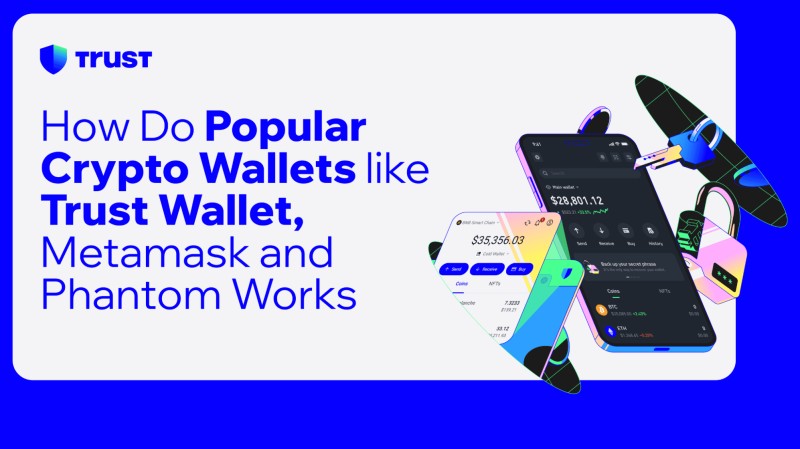
A Trust Wallet guide from February 11, 2025 compared custodial wallets, non-custodial wallets, Trust Wallet, MetaMask, and Phantom. Custodial wallets are easier to use and recover but you surrender control and face counterparty risk. Non-custodial wallets give you full control but you bear all the security responsibility.
Trust Wallet offers broad multichain support with a user-friendly interface. MetaMask dominates the Ethereum and DeFi space with thousands of dApp integrations. Phantom stands apart with its Solana focus - fast, low-cost transactions, native NFT support, and direct dApp integration. The March 2025 multichain expansion added Ethereum, Polygon, Bitcoin, and Base, but Solana remains the core.
The comparison makes clear: wallet selection depends on your technical experience, supported assets, desired ecosystem, usability preferences, and risk tolerance. If Solana and low fees matter most, Phantom crypto has a strong case. If you want broad multichain coverage, Trust Wallet leads. For Ethereum DeFi, MetaMask is the natural fit.
Supported Assets, Networks, and Platforms
Phantom crypto supports Solana and SPL tokens including SOL, RAY, and USDC, plus Ethereum, Polygon, Bitcoin, and Base. The wallet is available as a mobile app on App Store and Google Play, and as a browser extension for Chrome, Firefox, Brave, Edge, and other supported browsers.
The March 2025 overview listed characteristics supporting Phantom's use in DeFi and NFTs: approachable interface, direct DeFi integration, NFT support, low transaction costs, high speeds, multiple security features, built-in swapping, and Solana ecosystem integration. Phantom also described itself as Solana-centric while expanding multichain support.
Supported networks and tokens
- Solana and SPL tokens (SOL, RAY, USDC)
- Ethereum and compatible networks
- Polygon
- Bitcoin
- Base
JUP Airdrop Infrastructure Lessons
The Allium Team published "The Inside Story of the JUP Airdrop at Phantom" on February 27, 2024. Jupiter was the largest DEX aggregator on Solana, and the JUP distribution was nearly $700 million in tokens across nearly one million wallets - one of the largest crypto airdrops ever.
The WEN airdrop on January 26, 2024 was the dress rehearsal. More than one million wallets were eligible. Traffic surged to 8,000 requests per second, and Phantom's data infrastructure buckled. API Gateway and Lambda endpoints went down. Database connections exhausted, producing timeouts. More than 20,000 Lambda executions ran concurrently.
For JUP, Phantom assembled a dedicated team and ran 16 staging load tests plus two production tests. They tested six endpoints from 1,000 to 30,000 RPS using 10 machines. QuickNode and Triton each delivered 75,000 RPS of total capacity. Blowfish simulated every dApp interaction at up to 25,000 RPS. NAT Gateway expanded from 55,000 to 440,000 external ports.
Launch day produced the highest traffic Phantom had recorded: 90,000 RPS at peak, 477 million total requests over four hours. Traffic served six times faster than WEN, errors were ten times lower, and p95 response time was six times faster despite ten times the traffic. After four consecutive days of long work, Phantom helped hundreds of thousands of users claim JUP tokens.
JUP was a much larger infrastructure test for Phantom than the earlier PYTH and JTO airdrops. The event was a major liquidity event for Solana.
Market Position and User Distribution
The Great Repricing paper by Spencer Bogart and Jonah Burian from February 19, 2026 examined why crypto products gained traction while token prices stayed weak. Stablecoin volume hit $33 trillion, up 72% year over year. Retail transactions jumped from 314 million to 3.2 billion. Polymarket became a widely used forecasting product, and Phantom became a wallet used by millions.
The authors argued that value was moving up the crypto stack toward entities with direct user relationships. Phantom, Polymarket, Tether, Coinbase, Kraken, Circle, and Yellow Card were named as companies without tokens - "yet" - capturing value through distribution power. When blockspace is abundant and switching costs are low, infrastructure becomes interchangeable. Competition pushes infrastructure economics toward marginal cost, and value flows to applications that own the user connection.
The authors expected some tokens to shift from governance-only designs toward direct participation in application economics, tokenized equity, or direct claims on cash flows. Hyperliquid was cited as an on-chain application with a distribution strategy centered on one asset. Morpho, Uniswap, and Aave were described as moving toward a unified protocol-and-application economic model.
Phantom Wallet Setup And First Trade In Minutes
Why Phantom Crypto Matters for Your Setup
If you are looking to set up a new crypto account , Phantom crypto offers a path that does not hand custody to a centralized exchange. The non-custodial model means you hold the keys - but it also means you are solely responsible for safeguarding your private key, recovery phrase, device access, and transaction approvals.
For beginners, the approachable interface and built-in swapping lower the barrier to entry. The wallet also positions itself as a solid starting point for people new to self-custody , though the source makes clear that "safest" depends on your own habits - never share your recovery phrase, enable biometric locks, and use hardware wallets for larger holdings.
Experienced traders get perps with more than 100 markets, leverage up to 20x on some assets, and stop-loss / take-profit controls. The Cash feature adds a Visa debit card, bank funding, and P2P payments - turning Phantom from a pure wallet into something closer to a full financial app.
The market's stated demand is for a direct and demonstrable relationship among product usage, revenue, and asset value, rather than utility or scale alone.
Blockchain Wallets and the Bigger Picture
Phantom crypto sits in a crowded field. Trust Wallet brings the broadest general multichain coverage. MetaMask owns the Ethereum and DeFi orientation. Phantom's distinction is its Solana roots combined with expanding multichain support and unique features like perps and Cash.
The broader trend matters here. As wallets that manage keys on chains proliferate, the real competition is not features - it is user relationships. Phantom controls a direct user relationship and the flow of transactions, which is why the Great Repricing paper named it as an entity capturing value higher in the stack.
One market observer, Jay Yu, noted that major protocols including Avalanche, MetaMask, and Phantom had launched or were launching credit or debit cards. The pattern is clear: wallets are becoming financial platforms, not just storage tools.
Getting Started with Phantom Crypto
To get started with a wallet , you download the Phantom app from the App Store or Google Play, or install the browser extension for Chrome, Firefox, Brave, or Edge. The setup generates your private key locally on your device. You write down the recovery phrase and store it somewhere secure - offline, away from digital exposure.
Phantom Cash adds an extra layer for spending, but KYC is only required for off-chain features like the virtual account, direct deposits, and the debit card. On-chain features like holding tokens, swapping, and staking do not require KYC. The card requires applicants to be at least 18 years old, and fees may apply.
This matters for younger users: the source does not describe a dedicated a wallet for users under 18 within Phantom. The 18+ requirement applies to card features, and the non-custodial model means anyone with a device can create a wallet - but legal and jurisdictional restrictions vary.
Getting started steps
- Download the app or browser extension
- Generate your key pair locally
- Record the recovery phrase offline
- Set a strong password
- Enable biometric authentication on mobile
- Fund via buy, swap, or receive
Final Take on Phantom Crypto
Phantom crypto has grown from a Solana-only wallet into a multi-chain platform with perps, Cash, a debit card, and 15 million monthly active users. The non-custodial model gives you control but also full responsibility - there is no customer service to reset your password and no insurance if you lose your keys.
Whether it is the best decentralized wallet for crypto depends on what you value. If Solana integration, low fees, and a growing feature set matter most, Phantom crypto has a strong case. If broad multichain coverage is your priority, Trust Wallet may fit better. For Ethereum DeFi, MetaMask remains the default.
The bigger story is about where value flows in crypto. Apps and aggregators that own the user connection are capturing more economic value than infrastructure alone. Phantom is betting that being the interface between you and your assets - the app you open daily - is worth more than being another chain or protocol.
Control of the user interface and transaction flow creates distribution power. A company controlling distribution can monetize many on-chain actions.
Phantom Cash and Perps show the direction clearly - from a wallet that holds tokens to a platform that lets you spend, trade, and manage your finances in one place. Whether that bet pays off depends on execution, regulatory headwinds, and whether users actually want one app to rule them all. The 15 million monthly active users suggest they are trying.
Phantom Crypto at a Glance
Here is a quick recap of what Phantom crypto offers and what to watch for.
Phantom crypto quick recap
- Non-custodial wallet with Solana roots and multichain support
- 15 million monthly active users as of early 2026
- Perps trading on Hyperliquid with 100+ markets
- Phantom Cash with Visa debit card, bank funding, and P2P
- Regular security audits by Kudelski Security
- Hardware wallet support via Ledger
- Not open-source despite external audits
- Perps and Cash not available in all jurisdictions
The user relationship is the central crypto asset. Infrastructure products can become interchangeable when blockspace is abundant and switching costs are low.
If you are exploring wallets and want to understand what Phantom crypto brings to the table, start with the basics: download the app, secure your recovery phrase, and test with a small amount before moving larger holdings. The feature set is real and growing, but self-custody means no safety net - treat your keys like cash in a physical wallet, because in many ways, that is exactly what they are.
Key considerations before using Phantom crypto
- You control the keys - no custodial recovery option
- Recovery phrase must be stored offline and securely
- Perps carry significant risk - start small
- Cash features require KYC and 18+ age
- Availability varies by jurisdiction
- Phantom is not a bank - no deposit insurance

Comments on “Phantom Crypto Wallet Features, Security, and How It Compares”
No comments yet. Be the first to share your thoughts.