
Cryptocurrency Bubble or Future Money? Bitcoin, Blockchain, and AI Compared

What Counts as a Bubble
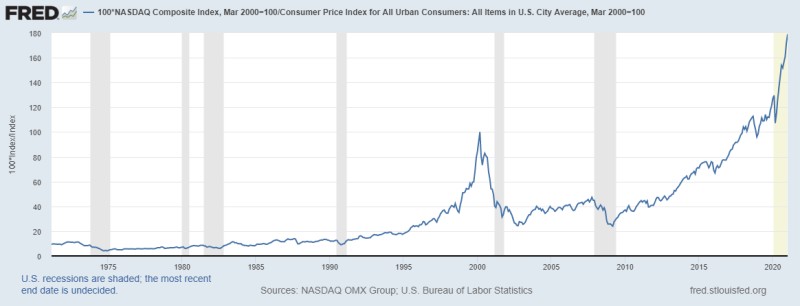
Financial commentators often use "bubble" to mean an asset is overvalued, has no value, or is heading toward zero. Noah Smith proposed a narrower definition: a bubble is an asset that rises in price and then crashes within a short period. On that definition, a bubble does not imply the asset is worthless. U.S. stocks have experienced several bubbles, and U.S. housing had a major bubble in the 2000s without becoming valueless.
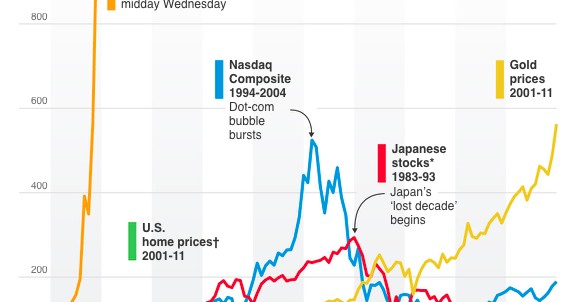
The distinction matters because many assets recover after a bubble. An investor who bought at the top of the Nasdaq bubble and held was up about 80% after adjusting for inflation. Someone who bought at the peak of the U.S. housing market in 2006 was also back in the black.
Not every asset recovers. The Nikkei remained below its peak more than 30 years later. Gold was still below its 2011 peak after inflation adjustment. GameStop was not expected to return quickly to the price reached during its 2021 surge, and Dutch tulips did not rebound to their historical peak.
Bitcoin has experienced several price surges and crashes. In 2011, when Bitcoin fell to around $32, Adrian Covert wrote in Gizmodo that the honeymoon was over and Bitcoin was falling fast.
A person who held Bitcoin from that 2011 crash was up by approximately 160,000%. An investment of $1,000 at the time would have grown into roughly the amount needed to become a millionaire. Smith noted that this recovery did not make the bubble rational. A large increase followed by a sharp collapse is more consistent with greater-fool speculation, herd behavior, and other market inefficiencies than with a stable estimate of fundamental value.
Bitcoin's Price History and Repeated Near-Death Events
In November 2017, Bitcoin was described as a fairly typical example of excess valuation and speculative market behavior. Its price had risen dramatically, drawing attention to volatility, trading volume, short holding periods, and the possibility that buyers were focused on future price appreciation rather than current utility.
By early December 2017, Bitcoin had passed $11,000 after being worth less than $800 a year earlier. A November 2017 analysis offered a running list of more than 180 articles declaring Bitcoin dead. The first listed item came from 2010, when Bitcoin was worth $0.23. By late 2017, Bitcoin was worth more than $8,000. The history of repeated "death" announcements did not rule out a bubble, but it demonstrated that Bitcoin was not disappearing after each crash.
In November 2018, one account put Bitcoin at about $6,500, up from $0.008 in July 2010, an increase of 81,250,000%. It described 2018 as a rough year in which Bitcoin's price declined by an average of 67% over the year. The same account compared Bitcoin's turbulent development with the dot-com bubble, noting that Amazon suffered negative results from heavy early investment before becoming one of the most successful companies of its time.

By early that year, Bitcoin was around $48,000. A person who bought at the late-2017 peak and held until then was up about 200%. Someone who waited until after the crash and bought on January 1, 2019, was up about 1,200%. A commentary on cryptocurrency and AI referred to a one-day fall of 30% in the value of some crypto assets as evidence that the crypto bubble was already deflating. The cited percentage did not describe the entire crypto market, only some of the assets in the market.
Crude $117, Crypto Crash, AI Bubble Burst
Why Bitcoin Has Demand Beyond Speculation
Three frequently cited sources of demand for Bitcoin and other cryptocurrencies are limited supply, concern about the long-term value of fiat currency particularly during periods of quantitative easing, and the appeal of anonymity or near-anonymity. These factors can explain some demand, but they do not necessarily explain why prices rose so rapidly.
The belief that blockchain would be adopted throughout finance was one proposed explanation. The counterargument was that blockchains can be created without cryptocurrency, and the success of blockchain technology would not be inseparably linked to the success of Bitcoin. A more direct explanation for the surge was that the price was already rising, attracting momentum buyers.
Noah Smith argued that Bitcoin can have fundamental value even if it never becomes a common currency. He compared it with "digital gold." Gold has nonmonetary uses, but part of its monetary value comes from serving as insurance against government instability or collapse. In medieval and early modern Europe, and in other premodern societies, gold could function as money for cross-border payments when governments were unable to maintain reliable fiat currencies.
Gold's total market value was estimated at a little over $10.6 trillion when Smith wrote. Bitcoin's market capitalization was about one-tenth of that. Smith argued that Bitcoin could be worth much more if it became a comparable hedge against global systemic failure.
He grouped several possible Bitcoin uses under "system failure": evading capital controls, moving money out of countries such as China in defiance of government restrictions, acting as a currency where governments have collapsed, preserving value where hyperinflation has made local fiat currency ineffective, buying drugs, and paying data ransom. These uses were presented as sources of fundamental demand whether or not they carried positive social consequences.
In this view, peer-to-peer financial systems become valuable when the existing system of governments, banks, and financial regulations fails.
Convenience Yield and the Demand for Non-Interest-Bearing Money
John H. Cochrane's November 2017 analysis began with the standard asset-pricing equation: price equals the expected present value of dividends. Bitcoin pays no cash dividends, creating a problem for valuation based only on future cash payments.
For an asset with no cash dividends to retain a positive price, Cochrane identified three possible explanations. Buyers may receive a noncash benefit from holding it. They may accept a lower financial return because the asset is more convenient for transactions. Or they may expect its price to keep rising, allowing appreciation alone to provide a competitive return.
Cochrane called the first two forms of value "convenience yield" and the third a "rational bubble." Dollar bills provide an example of convenience yield. They pay no interest and have a fundamental value of zero. At the time, one-year Treasury securities were risk-free and yielded about 1.5% more than holding dollar bills. People nevertheless hold cash because it is useful when making transactions.
Cochrane connected this cash dynamic to Bitcoin. In both markets, high turnover and short holding periods can coexist with higher prices. He compared that pattern with the high-priced stocks of 1999 and with tulip mania.
Bitcoin's convenience yield, in Cochrane's analysis, included avoiding government controls over capital and transactions. He listed ransomware, money laundering, and moving funds out of China as examples. These uses contain beneficial and destructive elements, but they can still create rational demand from someone who understands that Bitcoin may be a poor long-term investment but values access to funds outside conventional banking and government controls.
Cochrane was less enthusiastic about banning cash or Bitcoin. He argued that enforcement could harm undocumented immigrants and small businesses and could expand government surveillance of spending.
That view was disputed in comments. One commenter argued that the Federal Reserve held assets against dollars, stood ready to redeem them, and could use government bond assets or gold. Another commenter replied that Federal Reserve assets consisted largely of government bonds backed by federal taxing power. A further response noted that the U.S. government accepts dollars in payment of taxes.
The dollar's legal and institutional role was therefore disputed. Cochrane treated non-interest-bearing currency as having zero fundamental value and a convenience yield, while commenters emphasized redemption, tax acceptance, government backing, and the risk that excessive issuance or loss of state capacity could reduce the currency's value.
One commenter cited an estimate that 75% of U.S. currency circulated domestically, with nearly $5,000 per resident and expected growth. The discussion also referenced growth in offshore banking. Benjamin Cole quoted Leona Helmsley's remark, "Only the little people pay taxes," while arguing that offshore banking and tax avoidance had become too widespread for Bitcoin's demand to disappear with a single crash.
Bitcoin as Money, Store of Value, or Speculative Asset
Cochrane did not regard Bitcoin as good money. He described it as pure fiat money with no backing, whose price depended on limited supply, convenience yield, and speculative demand. He argued that its large fluctuations should also serve as a warning to advocates of returning to gold.
Cochrane predicted that stable-value cryptocurrencies offering one dollar per unit and low transaction costs would be more successful as money. He allowed for the possibility that a stable, government-debt-linked cryptocurrency could be displaced after a major inflation or sovereign-debt crisis by a stable currency not tied to government debt.
Other commentators offered different definitions. Robert Shiller described Bitcoin as a leading example of irrational exuberance. Joseph Stiglitz said Bitcoin was successful because it allowed circumvention and a lack of oversight. He argued that it should be outlawed because it served no socially useful function. Jean Tirole called Bitcoin a pure bubble and an asset without intrinsic value, saying it would be unsustainable if trust disappeared. He urged regulators to protect investors and prevent banks, insurers, and pension funds from accumulating large exposures.
Kenneth Rogoff's "best guess" was that Bitcoin's technology would thrive in the long run while Bitcoin's price collapsed. He said the result would depend on government reactions and the ability of alternative coins to penetrate the market.
Tyler Cowen, who had previously regarded Bitcoin as a bubble, later argued that it should be viewed as competing for part of the asset space occupied by gold and, to a lesser extent, art. He described gold as a "bubble" in its hedging role while maintaining that this did not make gold valueless. Gold can function as a focal asset and may not move in a simple, positive correlation with the market portfolio. Cowen argued that focality-based "bubbliness" can persist for centuries. He viewed Bitcoin as a strong competitor to gold as a hedge, particularly as gold's hedging role weakened during periods of low inflation and as China and India became more dominant in the gold market.
The term "currency" was also disputed. A commenter argued that something can be called a coin or currency without functioning as one. Bitcoin's role as a financial asset had appeared to grow faster than its currency role.
A commentary went much further, arguing that crypto had not become a currency because little of the activity was used for actual exchange. Vast quantities of dollars, pounds, euros, yen, and other real currencies were being invested in crypto assets, but the investment was described as being in hype rather than in a functioning alternative medium of exchange.
Other commentators rejected the idea that Bitcoin had no practical value. In the 2018 LSE discussion, Bitcoin was described as a peer-to-peer electronic cash system designed to remove financial institutions as trusted third parties. Transactions would be verified and permanently recorded on a distributed blockchain, helping prevent the same digital unit from being spent twice. The claim was that technology could replace the need for trust in intermediaries.
One commenter argued that the discounted-cash-flow model used for stocks and some other assets was not well suited to currencies because there is no accepted method for calculating the absolute value of a euro or another fiat unit. Models can describe relative exchange-rate changes, but Bitcoin would need an accepted currency valuation model before a large discrepancy from that model could establish that it was overvalued.
The same commenter argued that Bitcoin substitutes were more common than Cochrane implied. Hundreds or thousands of Bitcoin clones had failed because they lacked liquidity, branding, network effects, and differentiation. Bitcoin could therefore retain value even if its code and mining design were copied.
Rational Bubbles and the Problem of Infinite Price Growth
Cochrane was skeptical of rational-bubble theories in which an asset rises forever because later buyers expect still-later buyers to pay more. He argued that an indefinitely rising Bitcoin price would eventually exceed all U.S. wealth, all world wealth, all interplanetary wealth, and eventually the value of all atoms in the universe. At that point, the greater-fool or Ponzi structure would have to collapse or depend on irrational belief in the next buyer.
He also said rational-bubble theory did not adequately explain the association of price surges with high volatility, high trading volume, and short holding periods.
That account of rational-bubble theory was challenged. Tore Ellingsen said rational-bubble models require the rate of return to be smaller than the growth rate. He argued that Bitcoin could survive as a rational bubble representing a declining fraction of total wealth if other assets, such as gold, yielded returns below the growth rate. In that formulation, the bubble need not rise forever in nominal terms.
Eric Rasmusen asked about a "semi-rational bubble" in which 99% of investors could earn positive expected returns at the expense of a minority who do not understand the bubble. Hardy Hulley offered a more technical definition. In mathematical finance, a rational bubble can describe a discounted asset price that is a strict local martingale and therefore a strict supermartingale under an equivalent risk-neutral probability measure. The current price exceeds the discounted expected future price under that measure, but the model is consistent with rational equilibrium. It does not require the price to rise continuously or depend on identifiable "greater fools."
These arguments conflict with Cochrane's description of rational bubbles as belief in permanently rising prices. The disagreement is partly definitional: one account treats a rational bubble as a mathematically consistent price process, while the other describes a perpetual greater-fool narrative.
Valuation Models for Bitcoin
Several valuation approaches were compared in 2017.
Valuation Methods Compared
- Purchasing-power parity treats Bitcoin as a currency and asks how many goods and services can be bought with one unit. This method is difficult because Bitcoin is not widely accepted as a payment method, most buyers do not intend to spend it, and there is no central authority setting interest rates or inflation.
- Discounted cash flow treats an asset like a stock or bond by estimating future cash flows. Bitcoin does not generate recurring cash flows, so standard stock and bond methods are difficult to apply.
- Software-as-a-service valuation was proposed by investment manager Andy Kessler. He treated Bitcoin like a transaction-processing company such as Visa or MasterCard and used transaction volume and fees to produce an estimated Bitcoin value of $3 billion. At the time, Bitcoin's market capitalization was about $137 billion and its market price was approximately $8,000.
- The art-market analogy compared cryptocurrency to art. A 1955 Willem de Kooning painting may be described as worth $300 million because collectors, museums, critics, and the art market accept its price. A virtual or digital asset can also be valuable to an immersed community even if it appears to have little intrinsic value to outsiders.
The comparison did not prove that Bitcoin was worth $3 billion, because a transaction-processing comparison itself requires assumptions. It did illustrate the difficulty of using conventional valuation methods to approach a market price that was primarily supported by expectations of future resale.
One commenter proposed a labor-based theory of money. In that account, money should store the value of labor across time and space. The commenter cited a 1964 U.S. minimum wage of $1.25, equal to five silver quarters, and argued that the silver content would have preserved purchasing power better than the face value. Bitcoin's proof-of-work was described as an attempted recreation of labor input, but the commenter argued that it would fail because there would be no barrier to substitution. In this view, Bitcoin was being held mainly for speculation rather than used for purchases. The commenter also referred to Gresham's Law and argued that sound money should remain comparatively stable against goods and services.
Scarcity, Mining Costs, and the 21 Million Supply
Bitcoin's protocol has a maximum issuance schedule commonly described as 21 million bitcoins. Mining difficulty is designed to rise as the reward structure changes, making it progressively harder to produce the remaining bitcoins.
A commenter challenged any simple comparison with fixed-supply assets by noting that Bitcoin's future supply had not yet been mined and that extraction costs rise as mining becomes more difficult. The commenter argued that a return on Bitcoin must include those extraction costs and proposed a formula: RR = [BC(t+1) × P(t+1) - BC(t) × P(t) - (BC(t+1) - BC(t)) × C(t+1)] / [BC(t) × P(t)]. Here, BC is the quantity of bitcoins in circulation, P is the market price per bitcoin, and C is the extraction cost per bitcoin.
This creates a distinction between a fixed future issuance schedule and a fixed quantity already in circulation. Mining costs also affect whether a change in market price represents a real return to holders.
Cochrane argued that substitutes posed a more important long-term threat. Hundreds to thousands of Bitcoin-like projects were described as similar competitors, and private claims such as Bitcoin futures could satisfy some speculative demand without requiring investors to hold Bitcoin itself. In his view, restricted supply and a restricted supply of substitutes could sustain a price surge only for a limited period.
Others argued that the ability to copy Bitcoin did not eliminate barriers to entry. Potential barriers included proof-of-work security, the cost and difficulty of attacking a large network, developer talent, open-source code and testing, liquidity, brand recognition, network effects, the ability to create credible private claims or derivatives, and the cost of attracting users and maintaining infrastructure.
One commenter said changing a mining algorithm could create a clone with similar guarantees, but the clone would still need the adoption of users. Another commenter replied that proof of work created a barrier and asked why Bitcoin could not be displaced by a technically comparable coin.
Network-effect supporters argued that Bitcoin's security and adoption could be copied more easily than its users. In a hypothetical comparison, a saver choosing between a Bitcoin network used by 10% of the population and costing hundreds of millions of dollars to attack, and "Foocoin," used by 0.1% and costing $50,000 to attack, might still choose Bitcoin because of its security and network size.
Other comments argued that Bitcoin had the most tested open-source code in the cryptocurrency field and that copying code did not copy the developers who had produced and maintained it. Wikipedia and Craigslist were also cited as businesses that retained dominance despite being easy to imitate.
Forks, Clones, and Consensus
A fork splits a cryptocurrency network into incompatible versions. Bitcoin Cash and Bitcoin Gold were cited as examples of spin-offs created after disagreements over Bitcoin's direction. Critics asked whether spin-offs diluted the value of Bitcoin. Supporters said forks can coexist, much as different products, companies, or species occupy different niches.
Claims about the 21 million limit produced a debate over whether Bitcoin is truly trustless. Supporters argued that the limit is enforced algorithmically and that changing Bitcoin's supply requires agreement among the nodes running the protocol. They said thousands of participants and cryptographic rules make unilateral modification infeasible.
Other commenters argued that Bitcoin remains trust based because users and node operators must continue to follow the rules. They argued that governments, criminals, or other bad actors could exploit weaknesses, even if they could not change the protocol openly.
An additional objection concerned miner incentives. One commenter argued that miners generally sell newly mined coins at prevailing market prices but do not promise to buy them back at a guaranteed price. This unidirectional exchange differs from a bank or debt-based money system in which an institution is obliged to redeem its liabilities under specified terms.
The arguments did not resolve the question. Bitcoin's limited protocol issuance can coexist with uncertain mining costs, forks, competing coins, and futures. Whether those substitutes constrain Bitcoin depends on their security, liquidity, adoption, and network effects.
Polymarket, Binance, Google Hacks and AI Bubble
Speculative Demand, Convenience Yield, and Trading Volume
Cochrane separated fundamental demand from speculative demand. Someone who expects Bitcoin to rise for a week before an eventual crash does not need to believe that it has lasting fundamental value. Even certainty that Bitcoin would eventually fall to zero would not eliminate a short-term trading profit if the asset were volatile enough and the trader entered on the profitable side of that volatility.
Shorting would also require access to Bitcoin. A conventional short sale requires borrowing the asset, selling it, and later buying it back. Cochrane was unsure whether Bitcoin could be easily shorted in 2017. Even if direct shorting was difficult, private claims, derivatives, and futures could provide additional ways to speculate.
A surge therefore required demand, restricted supply, restricted substitutes, and limited short selling. Asymmetric information could increase trading. Because there were no conventional annual reports showing how much illicit or offshore money might seek to move, demand could be difficult to observe.
This framework predicted that price surges would be accompanied by restricted supply, high volatility, high trading volume, and short holding periods. Cochrane argued that these features appeared in Bitcoin and compared them with high-priced stocks, houses, and tulips. He also argued that "madness of crowds" alone did not explain the recurring relationship between supply constraints, turnover, and volatility.
A later commenter used futures-market data to challenge the simple relationship. The comment noted that Bitcoin's futures basis at CME or exchanges such as BitMEX could be used to observe convenience yield. When Bitcoin rose, the basis could rise and measured convenience yield could fall; when Bitcoin fell, the reverse could occur. The commenter asked why people appeared to prefer holding spot Bitcoin when its price was falling and confidence in it was being questioned.
Minsky's Five-Phase Framework for a Cryptocurrency Bubble
Lee Reiners, Ryan Clements, and Sean Semmler used Hyman Minsky's framework to argue that cryptocurrency was in the euphoria phase of a bubble. They did not claim that cryptocurrency technology would disappear and did not attempt to predict when or how the bubble would burst.
Minsky's framework has five phases:
Minsky's Five Phases
- Displacement: A new technology or financial innovation leads investors to expect higher economic growth and profits.
- Boom: Asset prices rise steadily and eventually outpace the fundamental improvements associated with the technology.
- Euphoria: Prices rise in a speculative frenzy because buyers expect to sell to others at higher prices. Sophisticated investors may recognize the bubble while continuing to participate.
- Profit taking: Sophisticated investors begin reducing positions and harvesting profits while less experienced buyers continue entering.
- Panic: Investors rush to sell, producing a rapid price decline. Leverage can intensify the fall by forcing margin liquidations.
The authors cautioned that not every asset bubble fits the framework neatly, but they considered it useful for comparing asset classes.
Displacement: Distributed Ledger Technology
Distributed ledger technology, or DLT, was described as the catalyst for the cryptocurrency boom. Bitcoin was the first major cryptocurrency and relies on blockchain, a form of distributed ledger. A shared, visible ledger and a consensus protocol could allow value to be transferred anywhere near instantaneously without a traditional intermediary.
Traditional financial institutions that had been cautious about cryptocurrencies were nevertheless developing DLT for clearing and settlement, payments, know-your-customer checks, and anti-money-laundering compliance.
DLT was also being used outside finance. Cargill used blockchain to trace turkeys from a store back to the farm that raised them. Walmart and other food companies worked with IBM on supply-chain tracking intended to help respond more quickly to foodborne illness.
Ethereum was described as a prominent DLT platform designed for decentralized applications and smart contracts. Early-stage companies used Ethereum to raise funds, usually in Ether, through initial coin offerings.
Boom: Investment, Awareness, and Rapid Price Growth
The authors reported that distributed-ledger companies received $14 million in venture capital across seven companies in 2013. By the prior year referenced in the analysis, nearly $400 million had been invested in 75 companies.
Almost nine years after Bitcoin's introduction, more than 1,000 cryptocurrencies existed with a combined market capitalization above $200 billion. Media coverage increased during this period. The Wall Street Journal had a full-time cryptocurrency reporter. Almost 80% of Americans had heard of Bitcoin, but only 14% said they had owned it.
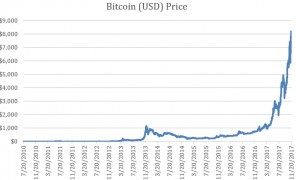
Bitcoin's price stayed between approximately $1 and $15 during its first four years. It rose more noticeably in mid-2013, reached an inflection point around mid-2016, and then grew exponentially.
As prices exceeded fundamentals, the authors argued that the market entered a phase in which resale expectations became the principal reason to buy.
Euphoria: ICOs, Media Stories, and Institutional Entry
During the euphoria phase, investors were described as funding anything using DLT, including projects without a viable product or credible business plan. The Ethereum.com domain was listed for $10 million. Newly formed or loosely affiliated groups used initial coin offerings to raise funds before establishing fully formed companies.
Cumulative ICO funding rose from approximately $300 million at the beginning of 2017 to $3.5 billion by November 2017. Celebrity endorsements amplified the boom. The U.S. Securities and Exchange Commission warned celebrities that promoting ICOs could violate securities laws.
The SEC analyzed the DAO in July 2017 and determined that it was a security subject to U.S. securities law, but it did not settle the legal status of every ICO. China and South Korea went further and prohibited ICOs.
Media stories supplied additional fuel. Headlines included "Idaho teenager becomes millionaire by investing $1,000 gift in Bitcoin – and wins bet with his parents" and "Meet The Man Traveling The World On $25 Million Of Bitcoin Profits."
The cryptocurrency investing class had previously consisted largely of younger, technologically experienced individuals. Deep-pocketed institutional investors began entering because of the returns generated by the market.
LedgerX became the first regulated platform offering Bitcoin derivatives in October 2017. Its CEO, Paul Chou, said: "Our regulated, institutional-grade platform enables participants who were sitting on the sidelines, to enter the digital currency market."
The Chicago Board Options Exchange announced plans for cash-settled Bitcoin options or futures in the fourth quarter of 2017 or early 2018, subject to CFTC review. The Chicago Mercantile Exchange announced plans for Bitcoin futures in the fourth quarter. Market observers also expected a Bitcoin ETF to become possible, although the SEC had rejected an ETF proposal in March 2017.
These regulated products could extend the boom by bringing more capital into crypto. They could also make exits easier and allow investors to bet against Bitcoin through futures, put options, or short ETF positions.
Profit Taking: Liquidity and Friction
Selling cryptocurrency in 2017 could be difficult because of transaction times, fees, security vulnerabilities, tax considerations, and limited market liquidity. A large sell order could push the price down sharply. Even an investor who believed the market was a bubble might delay selling because the cost or difficulty of exiting was high.
Regulated derivatives could reduce those frictions by providing more liquid markets and more direct ways to short the asset. The authors therefore expected new investment vehicles to prolong euphoria while also enabling sophisticated investors to take profits.
Panic: Leverage and Algorithmic Trading
In Minsky's panic phase, prices fall rapidly as participants attempt to sell. Leverage accelerates the decline when borrowers must liquidate positions to meet margin calls.
Little leveraged money was in the cryptocurrency market in 2017, but the authors expected borrowing and margin products to increase. Algorithmic and high-speed trading could also intensify a panic.
Electronic firms could swing prices in a thin market. If common algorithms sent orders to sell, there might be no buyers willing to absorb them. Exchange data could be unreliable or temporarily unavailable, making algorithmic decisions harder. Kraken had recently gone down for undisclosed reasons, while earlier failure of other major exchanges exposed the fragility of market infrastructure.
The authors argued that high-speed trading could destabilize an already unstable market and accelerate panic, drawing a parallel with the 2010 Flash Crash.
Unpredictable Timing and Recurring Near-Death Events
The analysis did not provide a date for the burst. Several events could have ended the boom but had little sustained effect on price:
Near-Death Events That Didn't Kill Bitcoin
- The world's largest Bitcoin exchange failed in 2014 and lost nearly $500 million in customer Bitcoin.
- The Bitcoin network split into two incompatible networks in August 2017 because of disagreements over transaction processing.
- China, then the largest cryptocurrency market, banned Bitcoin exchanges in September 2017.
- JPMorgan Chase CEO Jamie Dimon called Bitcoin a fraud.
- A proposed second network split was abandoned.
Supporters often treated these events as proof that Bitcoin was "unkillable." The Minsky framework authors argued that this certainty was itself characteristic of historical asset bubbles. Repeated near-death events do not make timing predictable, but the prior price increase remains relevant evidence of speculative euphoria.
A footnote in the analysis clarified the early Bitcoin price history: during its first four years, Bitcoin exceeded $15 on 29 occasions, with a maximum above $30.
Blockchain, Distributed Ledgers, and Technology Beyond Bitcoin
The LSE Business Review described Bitcoin's origins in a 2008 white paper published under the pseudonym Satoshi Nakamoto. The proposed system was a peer-to-peer electronic cash network that could transfer funds directly between participants without relying on banks or other financial institutions as trusted third parties.
Transactions would be verified and permanently recorded on a blockchain distributed across many computers. The design was intended to prevent double spending, in which the same digital unit might otherwise be used twice.
Bitcoin was the first decentralized cryptocurrency, and hundreds of other cryptocurrencies were created after it. Distributed ledger technology and cryptocurrency were therefore related but not identical. Financial institutions could adopt DLT without using Bitcoin, and the success of blockchain applications did not automatically guarantee success for Bitcoin as an investment or currency.
Potential nonfinancial applications included healthcare, banking, education, agriculture, supply chains, financial settlements, payment processing, and data recording. One 2018 account argued that blockchain's distributed approval process could make fraud easier to identify and prevent and could remove the need for a single centralized database.
That optimism was presented alongside unresolved questions. Blockchain systems still required communities of operators, software developers, users, and validators. The design could record transactions without revealing real-world identities by default. Exchanges and custodians could fail, and users could lose private keys. The distinction between a public ledger and a publicly identifiable transaction was repeatedly debated.
Stablecoins and Government-Linked Digital Money
Cochrane expected stable-value cryptocurrencies to be more useful as money than volatile coins. A currency intended to hold one dollar per unit with low transaction costs would solve some of the problems he associated with ordinary fiat money.
Richard Murphy's argument reached the opposite conclusion. He stated that even assets called stablecoins might lack sufficient backing and might not possess the exchangeability implied by their names. He argued that the crypto market had produced volatility and concentration rather than reliable value or a new method of exchange.
Stablecoins also raised lending and reserve questions. In response to a proposal for a public stablecoin and digital wallet, Murphy asked who would lend to people who used such a wallet and argued that a proposal offering banking to anyone with funds had to address the systemic role of lenders. He rejected the proposal as it stood.
A commenter compared crypto to gold, which governments and central banks hold and use, and questioned whether government acceptance might eventually give Bitcoin greater legitimacy. Other discussions referenced Bitcoin ETFs, regulated custody, and bank-backed cryptocurrency products as possible routes toward wider institutional acceptance.
Technical and Market Vulnerabilities
Hacking, Theft, and Exchange Failure
Mt Gox was repeatedly cited as a major failure. One account said the exchange filed for bankruptcy in 2014 after possible hacking and mishandling, losing about $450 million and helping push Bitcoin's price down as much as 80% in seconds. The Minsky analysis put the loss at nearly $500 million.
Earlier hacks were also part of Bitcoin's history. A 2011 attack demonstrated that digital assets could be stolen. In 2017, a $31 million hack involving Tether was described as a setback for tether but only a "speed bump" for Bitcoin.
A major exchange failing did not cause Bitcoin's long-term price to remain down, but such events demonstrated that the survival of the protocol did not protect users from losses at exchanges, custodians, or wallet providers.
Scalability and Exchange Reliability
The failure of major cryptocurrency exchanges on the day Bitcoin passed $10,000 highlighted the difficulty of handling traffic during a surge. Limited order-book depth and abrupt outages can amplify price movements.
The Minsky analysis also warned that large sell orders could produce outsized price declines in thin markets. High-frequency trading and unreliable public exchange data could worsen volatility, especially if many firms reacted to similar algorithms at once.
Developer Fragmentation and Forks
Disagreements over Bitcoin's technical direction produced forks and mutually incompatible networks. Excessive fragmentation could divide development, liquidity, and user confidence. The possibility of repeated forks meant that the original network's governance and consensus could become unstable even if the number of bitcoins under the original protocol remained capped.
Illicit Use, Capital Controls, and Political Risk
Bitcoin's history with illicit materials, theft, tax evasion, and money laundering was cited as a reason for official scrutiny. At the same time, evading capital controls, avoiding sanctions, or transferring wealth across borders was described as part of Bitcoin's foundational demand.
The tension is direct. The same border controls, privacy, and resistance to government seizure that attract some users also increase the risk of criminal use and regulatory intervention.
Governments threatened complete restrictions, account closures, or trading bans could sharply reduce demand. Regulatory action could also strip away some of the anonymity that supports Bitcoin's value, depending on how identity requirements were imposed.
South Korean Regulation and a Market Drop
On January 23, 2018, South Korea's Financial Services Commission announced that Bitcoin investors and traders would need real-name bank accounts for future transactions. The stated purpose was to reduce opportunities for cryptocurrency use in crime, money laundering, and tax evasion.
Immediately after the announcement, Bitcoin fell below $11,000 and Ethereum fell to $1,174. Some analysts argued that real-name accounts could improve security and bring more structure to the market even though the immediate policy appeared restrictive.
Energy Use and Mining
Bitcoin mining and proof-of-work systems require substantial electricity and computing equipment. Richard Murphy argued that crypto transactions consumed large amounts of real energy. Other commenters noted that mining difficulty rises over time and that mining costs affect returns.
AI and cryptocurrency were also described as energy intensive. Expanding either sector could require more power lines, substations, cooling systems, steel, concrete, copper, rare minerals, and water. At the same time, critics warned that this expansion could compete with climate goals and other public needs.
The environmental claim remained contested rather than quantified in the sources. One commenter argued that some AI and crypto energy inputs would continue to rely heavily on fossil fuels, while others emphasized that AI and crypto could eventually produce productivity gains. The sources did not provide a common calculation of total energy use.
Regulation, Gambling, and Financial Stability
Regulatory concerns went beyond fraud and criminal finance.
Jean Tirole argued that banks, insurers, and pension funds should be prevented from accumulating Bitcoin exposures until investors were better protected. Izabella Kaminska argued that Bitcoin futures and a weak market structure increased risk and that regulators needed to distinguish genuine investing from gambling.
Kaminska noted that licensed gambling zones had previously limited the geographic spread of gambling. The internet weakened those geographic restrictions. Cryptocurrencies could further undermine bans because digitally enabled backdoor channels could serve customers in restricted jurisdictions as long as some jurisdictions permitted the activity. She argued that gambling might therefore need to be stigmatized rather than promoted.
Banks create money through assets, liabilities, and deposit relationships, while Bitcoin mining creates new coins through proof of work and competition for computing resources. Tirole argued that Bitcoin mining did not produce seigniorage for the state and therefore did not support the same fiscal functions as conventional issuance. He also argued that widespread Bitcoin adoption could make it harder for central banks to conduct countercyclical policy.
The long history of currency was also used to argue that private innovation would eventually be regulated by states. Central banks could issue digital currencies, require identity verification, control access to banking relationships, or otherwise tilt the playing field. Rogoff noted that Bitcoin's current price depended partly on the expectation that some countries would continue allowing anonymous use. He also raised the possibility of state actors such as North Korea using Bitcoin.
A commenter warned that a crypto collapse could affect young investors who had lost confidence in conventional investments and could expose pension funds. Murphy responded that a bailout was highly likely, although the conditions attached to it would be decisive. He did not specify the conditions.
Arguments That Bitcoin May Persist
Bitcoin's repeated recoveries were interpreted in several ways. Smith saw repeated bubbles as part of a risky asset's return structure. High volatility can create high expected returns in efficient financial markets because volatility is a risk borne by holders. Only systematic, or non-diversifiable, risk should be rewarded in that framework, but Smith noted that Bitcoin was not a good proxy for stocks, bonds, or gold and therefore appeared to carry substantial asset-specific risk.
If Bitcoin were moving toward a higher long-term equilibrium, Smith argued, each bubble and crash could slow adoption by frightening away buyers. Over time, skeptics would learn that crashes did not permanently destroy Bitcoin and could enter the market. A lower initial price combined with the same eventual value would produce a higher long-run return. In this interpretation, Bitcoin appeared to be a risky but rewarding asset that was here to stay.
The same reasoning did not make Bitcoin HODLing a guarantee. Smith identified two possible causes of long-term failure: an unforeseen technological problem that made Bitcoin easier to attack than expected, and a coordinated global ban enforced by governments with enough power to confiscate wallets or prevent use. He regarded both as possible but remote. Bitcoin's protocol would remain available even if enthusiasm disappeared and the price approached zero.
Dogecoin's revival after periods of declining attention was cited as evidence that an open protocol can persist. A stock can be delisted, a company can fail, and a house can burn, but Bitcoin's code and network rules could not be destroyed by a price collapse alone.
The Long-Term Value of System-Failure Hedges

Smith identified several possible foundations for Bitcoin's value: use as a general currency if adoption eventually becomes widespread, use as a hedge against government or financial-system failure, use as "digital gold," use where capital controls prevent ordinary transfers, use where governments have broken down, use where hyperinflation makes fiat currency ineffective, and demand from prohibited markets and ransomware payments.
The slow rate at which people learn about Bitcoin and gain confidence was expected to generate positive expected returns. Once adoption approached saturation, returns would decline, and the market could overshoot before settling.
This framework differs from Cochrane's view that Bitcoin would remain a poor buy-and-hold asset, especially for an investor paying taxes. It also differs from Murphy's view that crypto had no fundamental use as money. Smith's position was that recurring bubbles did not answer the ultimate question of whether Bitcoin could retain value as a hedge or medium of exchange.
Bitcoin, Gold, and Physical Versus Digital Scarcity
Cochrane described Bitcoin as an electronic version of gold. A commenter objected that the two assets differ in important ways. Gold exists as a physical material and its geological supply is not created by consensus. Bitcoin exists because a community created and validates it. Its issuance depends on software, network participants, and human decisions.
The same commenter said gold's price varies and therefore did not support Cochrane's analogy as a stable monetary asset. Another commenter corrected the phrase "one ounce of gold is always worth one ounce of gold" by distinguishing physical self-value from its fluctuating market price. Gold is supplied through mining and recycling, is stored, and is used in industry. Its market price is affected by supply and demand.
Gold was nevertheless considered a more established hedge. It has physical uses, government holdings, a large market, and a history as money. Bitcoin had greater portability and programmable scarcity but lacked that physical base.
Some commenters compared gold with other monetary metals such as silver, noting that silver had been used as money in China before gold became dominant. This history was offered as evidence that money depends on social acceptance and durable scarcity, not simply on one substance.
Hacking, Proof of Work, and Alternative Cryptocurrencies
Some participants regarded proof of work as a barrier that an exact clone could not reproduce at comparable scale. Security depended on the hash rate and cost of attacking the network, not merely on copying the mining code. Branding and network effects could also preserve Bitcoin's lead even when substitutes were technically similar.
Others maintained that an algorithm could be copied and that thousands of Bitcoin clones had already failed. A proposed test was to create thousands of substantially identical systems and observe whether Bitcoin's price collapsed. Network effects meant the test was unlikely unless clones could attract users and liquidity.
A commenter also noted that "Bitcoin Cash" and "Bitcoin Gold" showed how forks could create new valued assets out of an existing network. Whether those spin-offs reduced Bitcoin's value, occupied different niches, or simply fragmented the market remained unsettled.
Some Bitcoin advocates described the system as trustless because changing supply required protocol-wide consensus. Other participants described it as trust based because users, validators, developers, and governments could violate, abandon, or pressure the system. Both descriptions were retained in the debate.
The label "crypto" also covered widely different systems. Bitcoin was often used as a store of value or speculative asset; Ethereum was designed for applications and smart contracts; stablecoins sought a different monetary function; and many other tokens had no widely accepted use. The failure of a particular token did not necessarily invalidate every blockchain network, while the success of blockchain technology did not establish the value of every token.
Historical Research Framing After the 2008 Financial Crisis
A research article by Asim Karaomerlioglu examined the nature of blockchain and the extent to which cryptocurrencies should be understood as financial bubbles. It placed the emergence of the technology in the historical context of the 2008 economic meltdown. The stated research scope included the historical, sociological, and financial characteristics of the blockchain revolution. It also intended to compare cryptocurrency euphoria with major historical bubbles, especially the structure and consequences of Ponzi schemes. The article's keywords were blockchain, Bitcoin, and finance. The accessible source did not provide additional empirical findings beyond that research framework.
Crypto or AI: Two Revolutionary Pitches Compared
Richard Murphy's comparison began with the question: "What is going to cause the next crash? Is it crypto with its promise to replace money, or is it AI with its promise to replace thinking?" He summarized his position with two statements: "AI doesn't think. Crypto isn't money."
Both technologies were described by their supporters as revolutionary, but Murphy argued that both depended more on belief and hype than on demonstrated substance. He described crypto's main motivation as greed and AI's main motivation as fear, especially fear of missing out and fear of falling behind.
Crypto's "Digital Democracy" Narrative
Crypto was sold as "digital democracy" and as money free from states and banks. Its libertarian rhetoric promised escape from regulation, taxation, and accountability.
Murphy argued that the unaccountability, fraud, crime, and regulatory escape associated with blockchain did exist. His complaint was that these outcomes had not produced the broader freedom promised by proponents. He also argued that crypto had not become a practical currency. Most crypto activity involved investing fiat money in an asset expected to appreciate rather than using the asset for exchange.
He described the larger-fool sequence as follows: existing prices attract new buyers, new buyers push the price higher, still higher prices encourage another group of buyers, and existing holders can sell to the new entrants while retaining a gain. He called that sequence the definition of a Ponzi scheme and compared the mania to the seventeenth-century tulip mania. He acknowledged fraud and failed exchanges as facts rather than rumors. He also cited energy use and argued that the sector's moral credibility had been damaged by fraud.
This view conflicts with descriptions of Bitcoin as a medium of exchange, hedge against systemic failure, or digital gold. It also conflicts with the view that demand can be based on network effects, final scarcity, privacy, or resistance to capital controls rather than only on resale expectations.
AI as an Industrial-Revolution Substitute for Human Thought
AI has been marketed as the next industrial revolution and as a way to automate human thought. Claims have been made that it could handle tasks ranging from legal analysis to intimate or emotional decisions.
Murphy argued that these claims rested on a false description of AI. Current systems recognize patterns in behavior and manipulate existing material. He said they do not independently think, understand in the way people do, or create something genuinely new. On that view, AI was not producing the innovation required for a new industrial revolution.
He also described the sector as being dominated by corporate monopolies controlling data and computing power. He pointed to concentration in U.S. stocks, claiming that all seven of the largest companies responsible for much of the recent rise in U.S. market values were connected to AI in some way.
The expectation of an AI-driven productivity miracle was central to high valuations. Murphy argued that the promised gains had not yet appeared and that some future period could instead be spent correcting AI errors. He said the market narrative hid costs for energy, surveillance, and labor displacement.
He described AI's bubble as financial, moral, and existential. His moral concern involved the concentration of control and the social effects of treating code as a substitute for care. His existential concern was that a system described as intelligent could influence society without the judgment or care associated with human intelligence.
What the Sources Agree and Disagree About About AI
Several participants accepted the claim that AI was overhyped while rejecting the claim that it had no value.
One comparison described AI as a tool similar to a calculator or spreadsheet. It could improve worker productivity, reduce staffing in some sectors, and perform some tasks quickly, but its effects would differ by industry. The commenter expected productivity gains while rejecting the scale of claims that AI would have an impact comparable to the internet. Another comparison said AI hype resembled the millennium bug: technical experts appeared credible partly because they discussed a threatening technology in terms that sounded sophisticated.
AI was also said to show genuine promise in areas such as medical imaging, even as commercial large-language-model output could overwhelm more reliable applications with low-quality text.
A participant described using a chatbot to pursue an insurance claim. The system could not understand the request, asked the person to rephrase it, and offered predetermined options rather than allowing a free-form question. The participant eventually reached the answer through a different route, but not on the same day. The example was offered as evidence that AI can perform some tasks quickly while failing when presented with an unfamiliar situation.
Other concerns from participants included companies reducing staff and later rehiring them, workplace decisions made without enough understanding of the systems involved, and "cyberpsychosis" among people dealing with loneliness or mental-health problems through extended interaction with AI.
Murphy replied that failures often resulted from users not programming or using the systems correctly. A participant then compared that response to "no true Scotsman": if a system were truly intelligent, it should require less skill than human work, not more.
The debate therefore separated three questions: whether current AI is useful when properly configured, whether its capabilities justify the scale of financial claims being made, and whether its social and environmental costs justify its deployment. The sources did not resolve those questions.
AI Investment, Market Concentration, and Circular Financing
Murphy argued that large companies were spending billions in dollars, pounds, euros, and yen because they feared competitors might find a valuable AI application. The problem was that companies did not know what use they were afraid of losing.
He expected investment to stop when investors concluded that the spending would not produce the returns they required. If productivity gains arrived only 20 or 25 years later, they would not satisfy investors evaluating returns over much shorter horizons.
A commenter raised concerns about "vendor financing," in which companies such as OpenAI, Oracle, and NVIDIA reportedly awarded one another multibillion-dollar contracts. The commenter argued that reciprocal deals could conceal weak returns on capital and questioned whether any real economic value was being created.
Additional concerns focused on public and private data. One commenter referred to a reported £260 million arrangement involving the Tony Blair Institute and UK public data, including NHS data, and asked whether such a sale would further weaken public control over a valuable national asset.
Murphy also argued that AI and crypto diverted "social energy" into speculative profit while leaving the real economy with fewer resources for housing, the environment, flood defenses, and other concrete needs.
The Shared Emancipatory Narrative
Murphy argued that crypto and AI both present themselves as emancipatory: crypto is presented as freeing money from state and banking control, and AI is presented as freeing society from human labor and thought.
In his account, both concentrate wealth, energy, and control in a small number of institutions. Both attract investment through stories of freedom, and both can convert social resources into financial gains without producing the promised broad-based benefit.
He contrasted the emotional drivers: crypto is described as greed-driven, and AI is described as fear-driven. Crypto investors may seek to participate in a price rise before a crash. AI companies may spend heavily because they fear being the first to miss a commercially important application. In both cases, the spending or buying depends more on expected action by other participants than on a demonstrated return.
Crypto's Investment and Technology Counterarguments
Participants offered a more favorable view of Bitcoin and blockchain.
One commenter described Bitcoin as a deliberately designed system with a finite supply comparable to gold. The commenter said many fortunes would be made and lost because it was volatile and viewed it as primarily a system for illegal activity or gambling. Even this favorable account emphasized extreme volatility and doubted that most people should hold it.
Another commenter described Bitcoin as a financial asset that had grown faster than its currency role. Another commenter expected Bitcoin to persist even if other cryptocurrencies failed.
Supporters pointed to mathematical limits on issuance, a public transaction ledger, mathematical security for private keys, cross-border transfers, resistance to capital controls, an inability to confiscate Bitcoin through a conventional seizure, network effects and a growing developer ecosystem, and insurance-like value against monetary or political failure.
Critics answered that the public ledger did not automatically reveal real-world owners. Murphy rejected the claim that everyone could inspect every transaction without decryption codes. Other participants argued that pseudonymity and the need to protect private keys were compatible with transparency: the amounts and transaction structure were public, while identities were separately protected or unknown.
Mining was described as turning electricity and computing work into new coins. New coins were free to a miner successful enough to solve the relevant proof-of-work problem, although the mining process consumed substantial energy and hardware.
The art-market analogy also appeared in the crypto discussion. Critics said cryptocurrency investments were gambling because real capital did not expand a business or produce goods. Supporters replied that art, racehorses, paintings, and other assets could also have value primarily because a market accepted them. Their persistence, scarcity, and social acceptance could sustain prices.
Stablecoins were disputed on the same basis. Supporters saw a digital representation of a fiat unit as a way to improve payment access. Critics argued that value depended on the quality of backing, redemption, reserves, governance, and the broader banking and legal system.
Crypto's Effects on Banking, Taxation, and Government
Crypto was discussed as a tool for evading capital controls, avoiding sanctions, moving wealth offshore, and reducing the reach of tax authorities. Governments therefore face a dilemma: restrictive rules may be difficult to enforce, while permissive rules may facilitate crime and capital flight.
Possible responses included real-name accounts, exchange regulation, reporting requirements, restrictions on mining, taxes on transactions, or limitations on participation by banks and regulated institutions. The source material did not settle which controls would be effective.
Supporters of Bitcoin argued that widespread enforcement could push activity underground without removing demand. Critics argued that technical barriers and international coordination already made complete enforcement unlikely.
The discussion also noted the possible macroeconomic consequence of large-scale migration into crypto. A commenter warned that governments could lose tax revenue and called for greater taxation of assets that cannot move, such as land and roads. Other participants argued that taxing immobile property could be an alternative to taxing mobile capital and income.
Possible Bailouts and Wealth Concentration
Participants asked who would hold the gains if AI or crypto markets collapsed and whether ordinary investors, pensions, or governments would bear the losses. One commenter referred to warnings that a crypto collapse could be worse than 2008 and said pension funds were investing in crypto.
Murphy said a bailout was highly likely, while emphasizing that bailout conditions would matter. He did not specify the conditions.
The concentration of wealth was a repeated concern. Crypto was described as concentrating power among a small number of new market participants. AI was described as concentrating data, computing infrastructure, and market value among large corporations. In both cases, the technology was sold as liberating while the financial gains could remain concentrated.
Social and Institutional Effects of Both Technologies
AI was connected to surveillance, labor displacement, data ownership, public procurement, energy demand, and corporate concentration. Crypto was connected to surveillance by blockchain analytics, illicit finance, tax evasion, capital flight, financial exclusion, energy use, and speculative losses.
Both sectors could produce real technologies even if some financial claims were inflated. The blockchain could still provide distributed ledgers for clearing, settlement, supply chains, and recordkeeping even if many cryptocurrencies failed. AI could still perform useful classification, imaging, and automation tasks even if it did not "think" in the way its marketing implied.
The strongest disagreement concerned what should count as value. A system can be technically useful while its token price reflects speculation. It can also have speculative value while providing little practical utility. Conversely, the absence of cash flow does not by itself prove that an asset cannot store value or provide insurance.
Murphy's stated alternative was to invest in people, care, sustainable production, and technology that serves society rather than extraction and speculation. He argued that the future could not be built on hype, cryptocurrency coins, or code alone and that intelligent systems needed to remain grounded in human cooperation rather than in AI, crypto, or technology as an end in itself.




Comments on “Cryptocurrency Bubble or Future Money? Bitcoin, Blockchain, and AI Compared”
No comments yet. Be the first to share your thoughts.