
How to Choose the Best Crypto ETF for Your Portfolio and Maximize Returns
Crypto ETFs Are Not All the Same
I have looked at a lot of these products. There is no single best crypto ETF for every portfolio. The right pick depends on your risk tolerance, the index it tracks, whether it holds actual coins or derivatives, the fees, the fund structure, and where it trades. Crypto ETPs give you regulated, exchange-listed exposure to bitcoin, ether, and other digital assets without forcing you to hold coins directly or manage wallets, private keys, and blockchain infrastructure. That convenience has a cost. You need to understand what you are buying.
What Are Exchange Traded Products
An Exchange-Traded Product, or ETP, is a broad category of financial instrument traded on stock exchanges. It tracks an underlying asset - a stock index, commodity, currency, or cryptocurrency. An Exchange-Traded Fund , or ETF, is a specific type of ETP structured as a fund. It typically holds a portfolio of the assets it tracks. A spot crypto ETF holds cryptocurrency in custody and gives you exposure to its market price through a traditional brokerage account. You do not manage the cryptocurrency yourself.
Main ETP Structures
- ETFs - structured as funds, typically hold actual assets
- ETNs - unsecured debt instruments issued by financial institutions, no underlying asset held
- ETCs - trade like ETFs but not legally funds, can be physically backed
- Leveraged and inverse ETPs - for experienced traders, short-term only
ETNs add issuer risk. If the issuing institution defaults, you can lose money even if the underlying cryptocurrency performs well. Leveraged and inverse products reset daily. Their longer-term results can diverge wildly from the underlying asset because of compounding and volatility. They are generally unsuitable for long-term holding.
Top 10 Bitcoin ETFs ranked with fees and custodians
How Crypto ETFs Get Their Exposure
This is the most important thing to understand. The exposure method determines how the fund behaves, what risks you take, and what you actually own.
Exposure Types
- Spot crypto ETFs - hold actual cryptocurrency in secure custody (examples: IBIT, GBTC, FETH)
- Futures-based ETFs - use futures contracts, do not necessarily hold the cryptocurrency (example: BITO, EFUT)
- Synthetic crypto ETFs - replicate price movements with derivatives like total return swaps, more common in Europe
- Thematic or basket ETFs - hold multiple crypto-related assets: large cryptocurrencies, blockchain company stocks, mining companies, DeFi infrastructure (example: BITS)
Spot structures provide direct asset-price exposure. But they remain tied to the volatility of the underlying cryptocurrency and carry fund expenses and market-price risks. Futures-based funds can diverge from spot returns because of contract roll costs and futures pricing. Synthetic funds introduce derivative and counterparty considerations. Thematic funds combine companies and crypto assets, so their result may differ from the price of bitcoin or ether by itself.
Fees Eat Returns Over Time
Management fees reduce your returns. Period. One fee comparison identified these as among the cheapest crypto ETFs globally: ARK's ARKB at 0.21%, BlackRock's IBIT at 0.25%, Fidelity's FBTC at 0.25%, and CoinShares European products at 0.25%. A fund's fee should be considered alongside its tracking method and exposure type. Spot funds incur custody and operating costs reflected in the expense ratio. Futures-based funds incur roll-related effects. Synthetic funds introduce derivative considerations. Thematic funds can hold equities, ETPs, and digital assets with different cost structures.
ETF shares are bought and sold at market price rather than net asset value. They may trade at a premium or discount to NAV. ETF shares generally are not individually redeemable from the fund, and brokerage commissions reduce returns.
These trading mechanics distinguish ETF ownership from direct ownership of the underlying cryptocurrency. Fees also matter when comparing an ETF with a manually assembled crypto portfolio. In a 2021 direct-purchase case, Coinbase Pro's standard trading fee was 0.50% at the time, with lower rates for higher volume. That was a direct-asset trading fee, not an ETF expense ratio.
Index and Holdings Determine What You Actually Own
The index determines what a fund is intended to track and the characteristics of its exposure. You need to check whether the fund holds a single cryptocurrency directly, tracks a futures contract, uses swaps, holds a basket of cryptocurrencies, holds shares of crypto-related companies, mixes digital assets with equities, uses physical custody, or obtains exposure indirectly through other investment vehicles. A spot ETF's value is primarily connected to the held cryptocurrency. A futures ETF can diverge because of contract rolls and futures pricing. A synthetic fund can introduce derivative exposure. A thematic fund can combine companies and crypto assets.
Questions to Ask About the Index
- Does it hold a single cryptocurrency or a basket?
- Is exposure direct (spot) or indirect (futures, swaps)?
- Does it include equity holdings of blockchain companies?
- Does it seek to replicate the index fully or sample components?
The MarketVector Stablecoin Technology Index and MarketVector Tokenization Technology Index illustrate more specific index rules. Both are rules-based indexes comprised of companies and exchange-traded products involved in their respective technologies. Their associated funds seek returns that generally correlate, before fees and expenses, with the total return performance of the underlying indexes.
Why most investors misread Bitcoin ETF differences
New Categories: Stablecoin and Tokenization ETFs
Amplify ETFs launched two new funds in late 2025: the Amplify Stablecoin Technology ETF (STBQ) and the Amplify Tokenization Technology ETF (TKNQ). They characterize them as first movers in their categories. Amplify reported more than $16.6 billion in assets under management as of November 2025.
Stablecoins are digital assets engineered to maintain price stability relative to fiat currencies. Amplify cited more than $9 trillion in annual stablecoin transaction volume and analyst estimates that the market could grow from roughly $300 billion to more than $3.7 trillion by 2030. STBQ targets equities and digital assets involved in payments technology, digital-asset infrastructure, trading platforms, stablecoin-linked economic activity, and decentralized-finance use cases. At rebalance, it is designed to include 25% to 50% in crypto assets tied to stablecoin and DeFi use cases.
Tokenization represents real-world assets - real estate, equities, bonds - as digital tokens on a blockchain. Potential effects include transparent ownership verification, fractional investing, faster settlement, and increased access to traditionally less-liquid markets. Amplify cited projections that tokenized assets could grow from $176 billion to more than $3.6 trillion by 2030. TKNQ targets companies and digital assets involved in tokenization platforms, blockchain infrastructure, exchanges, custodians, brokerages, and financial institutions advancing digitization of real-world assets. At rebalance, it includes 25% to 50% crypto-related assets meeting defined thresholds.
Stablecoins and tokenization are becoming important components of modern financial infrastructure, and with STBQ and TKNQ, we're continuing our work to deliver ETF solutions that help investors access these advancing areas of the market.
Risks You Cannot Ignore
An ETF simplifies access but does not remove the underlying asset's price risk. Bitcoin, ether, and other cryptocurrencies remain highly volatile. Tracking error can be more significant in futures-based and synthetic products. Funds that sample an index rather than replicate every component may produce different results. Futures-based ETFs may diverge from spot returns because of contract-roll costs and futures trading at premiums or discounts. ETNs are unsecured issuer debt. Synthetic products may depend on derivative counterparties. Leveraged and inverse ETPs target daily moves - their longer-term results can be affected by daily rebalancing, volatility, and compounding.
Principal Risk Categories
- Underlying crypto volatility - ETF does not remove price risk
- Tracking error - funds may fail to match stated index performance
- Futures roll and premium effects - futures ETFs diverge from spot
- Issuer and counterparty exposure - ETNs and synthetics add default risk
- Daily reset and compounding risk - leveraged/inverse products unsuitable for long term
- Regulatory and jurisdiction risk - treatment evolves and differs by country
- Tax uncertainty - cryptocurrency tax treatment varies by investor and jurisdiction
STBQ and TKNQ are non-diversified funds using a passive indexing approach. They seek to correspond generally with their indexes before fees and expenses, but there is no guarantee of success or high correlation. They may obtain indirect cryptocurrency exposure through other investment vehicles. They do not invest directly in bitcoin, ether, XRP, or solana. These indirect cryptocurrency investments are characterized as highly speculative, extremely volatile, and subject to uncertain tax treatment. Foreign-security risk, technology risk, concentration risk, and general fund risk also apply.
The January 2024 Spot ETF Catalyst Lesson
A January 2024 analysis argued that a highly bullish spot-crypto-ETF catalyst had already been discussed and forward-priced in the short term. The preceding two-month rally in equities and crypto was described as anticipating lower inflation, an end to the rate-hiking cycle, expected rate cuts, improved liquidity, and renewed inflows into crypto markets. The concern was that bullish conditions had been priced in too quickly. If incoming data failed to validate those conditions, equity and crypto markets could decline sharply.
"Buy the rumor, sell the news" describes a situation where an anticipated event becomes heavily discussed and incorporated into market prices before it occurs. By the time the event is released, some participants may use the resulting demand to exit positions. Two requirements for a major catalyst to produce a sustained bullish move: the news must be important, and it must be new and surprising. A catalyst anticipated for months may lose its surprise effect. Large participants can position before the announcement, then sell into demand from people reacting to the release.
By January 2024, approval itself was not considered a surprise because so many market participants expected at least some applications to be approved. The principal surprise would have been rejection.
Crypto influencer sentiment was used as a possible indicator of market tops and bottoms. Widespread bullish sentiment could increase the probability of a top. The January 2024 analysis found significantly more bullish than skeptical commentary about the ETF catalyst, especially regarding short-term price impact. Many crypto influencers cover only the crypto sector, may have exposure to crypto-related products, and may receive revenue from audience attention or affiliate activity. Their forecasts may be treated as sentiment indicators rather than a single consensus.
Long-Term vs Short-Term Effects
Over the longer term, spot ETFs were expected to give large institutional investors regulated access to crypto exposure, reduce the need to hold crypto on exchanges or in self-custody, increase institutional participation, increase total inflows and market capitalization, and expand the influence of large financial institutions within the crypto market. The source expected this institutional expansion to occur over time rather than as an immediate flood. It specifically rejected the expectation that ETF approval would cause enough short-term demand to absorb available crypto supply.
A cited estimate placed potential BlackRock-related ETF assets at nearly $2 billion. Compared to a crypto market capitalization of roughly $1.5 trillion, $2 billion was characterized as too small to create a supply-absorbing short-term rally. Early institutional inflows had already helped drive the preceding rally, while expected post-approval inflows were much smaller. Large institutions that had already positioned before the ETF news could become sellers if later flows failed to add enough demand.
Greater institutional participation could increase crypto liquidity and market capitalization while also increasing the influence of large centralized financial institutions over a market previously characterized as decentralized. The near-term projection was not necessarily an extended bear market but a forecast of high volatility, potentially including a large downside move followed by a rally.
Ethereum ETF showdown: staking yields and fee traps
Historical Analogues: 2017 Futures Launch and 2022 Risk-Off
The introduction of cryptocurrency futures markets in 2017 was presented as a case where a highly anticipated product launch was followed by a major decline and crypto market top. Throughout most of 2017, global markets and U.S. equities were rising. The Federal Reserve began a soft rate-hiking cycle. Global markets reacted to tighter conditions, and a broader risk-off response appeared near the beginning of 2018. U.S. equities and other risk assets sold off as crypto peaked. Crypto and U.S. equities are both sensitive to global liquidity because both have substantial technology exposure. A crypto bull market during a broader equity risk-off cycle was considered less likely.
The 2022 crypto decline was associated with bond-market losses, falling equities, withdrawal of global liquidity, regulatory catalysts, and a broader risk-off environment. Bitcoin also reached its cycle top during the same period. Global risk-off cycles were identified as among the largest contributors to the end of crypto bull markets. The risk-off setting was described as more important to short-term ETF performance than the mere presence of a new regulated investment product.
Manual Basket vs Buying an ETF
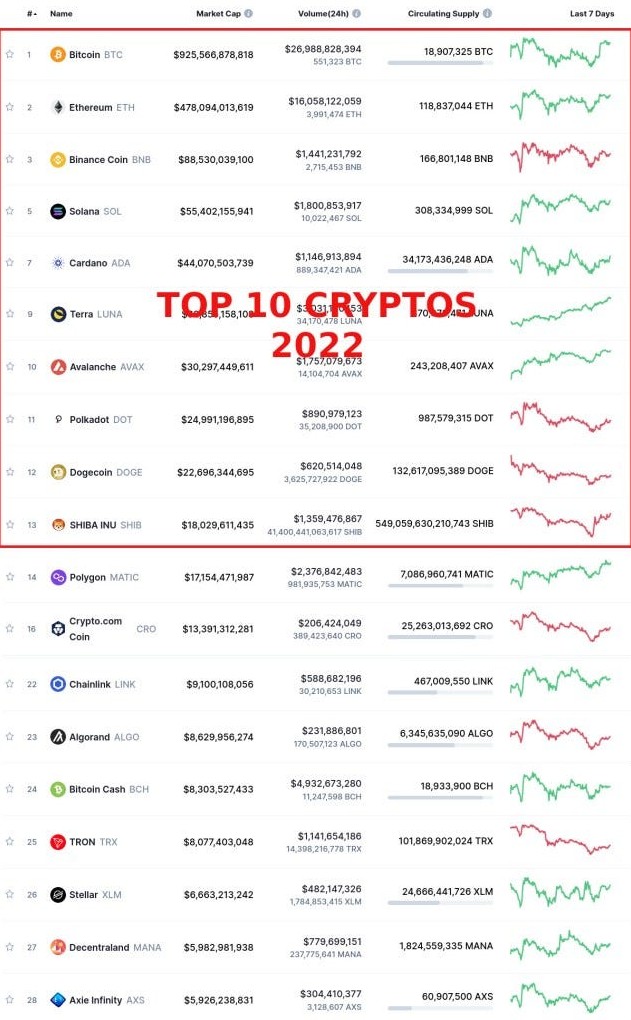
A 2021 case study built a manually assembled cryptocurrency portfolio - called an "ETF" in quotation marks - for 2022 tracking. Total investment: $150. Uneven allocation across the top 20 cryptocurrencies by market capitalization. Stablecoins and XRP excluded. Bitcoin and ether required a combined allocation of at least 20%. The author normally concentrated on bitcoin and ether but wanted exposure to larger price movements from smaller cryptocurrencies.
CoinMarketCap identified the top 20 assets. Stablecoins excluded manually. Market-cap rankings changed quickly. Tron (TRX) was excluded because it was not available on Coinbase Pro at the time. Luna was not available directly; Wrapped Luna (WLUNA) was used for price exposure. The author spent two days deciding when to enter. During that delay, several candidate cryptocurrencies increased substantially. The observation: attempting to time the market is usually difficult. Purchases completed around noon on December 23, 2021. Price movements and trading fees caused the final allocation to differ slightly from the target.
This project illustrates the difference between a diversified crypto basket and an ETF. It required coin selection, allocation decisions, exchange availability, direct purchases, trading fees, and potentially self-custody. An ETF instead provides exchange-listed exposure through fund shares and an underlying index or portfolio. The author's preferred wallet at the time was the Ledger Nano S, with a possible future upgrade to the Bluetooth-enabled Ledger Nano X.
How to Pick the Right One for You
Start with your goal. If you want direct bitcoin exposure through a regulated vehicle, a spot bitcoin ETF like IBIT, GBTC, or FBTC makes sense. Compare fees - they are all around 0.25% now. If you want ether exposure, look at FETH or other spot ether ETFs. If you are in a jurisdiction where spot ETFs are not available, futures-based or synthetic products may be your only option. Understand the roll costs and tracking error. If you want diversified crypto exposure without picking coins, a thematic fund like BITS gives you a mix of futures and blockchain equities. If you believe in the stablecoin or tokenization narratives specifically, STBQ and TKNQ offer targeted exposure - but they are non-diversified, concentrated, and do not hold bitcoin or ether directly.
Quick Decision Framework
- Direct spot exposure → spot ETF (check custody, fees, exchange)
- No spot access in your jurisdiction → futures or synthetic (know the roll risk)
- Diversified crypto + equity mix → thematic/basket ETF
- Specific thesis (stablecoins, tokenization) → niche thematic ETF (accept concentration risk)
- Short-term trading only → leveraged/inverse ETPs (not for holding)
Check the exchange and jurisdiction. A product listed on a major U.S. exchange offers different investor protections than one listed only in Europe. Regulatory treatment continues to evolve. Tax outcomes differ by investor and jurisdiction. The largest crypto ETF by assets is not necessarily the right one for you - it just means more people bought it. ETF share price trades at market, not NAV, and can carry premiums or discounts. Brokerage commissions reduce returns.
What This Means for Your Portfolio
Crypto ETFs are a tool. They solve the custody and access problem for investors who do not want to manage wallets, private keys, and exchange accounts. They do not solve the volatility problem. They do not solve the regulatory uncertainty problem. They add a layer of fees and structure risk. The best cryptocurrency ETF is the one that matches your risk tolerance, your access, your tax situation, and your actual thesis - not the one with the most marketing behind it.
If you are learning how to invest in cryptocurrency , an ETF can be a reasonable starting point. It looks like a stock, trades like a stock, and lives in your brokerage account. But it is not a stock. It is a wrapper around volatile assets with their own dynamics. Stock cryptocurrency exposure through mining companies or blockchain infrastructure plays differently than direct coin exposure. Invest in crypto through an ETF if you want the wrapper. Buy the coins directly if you want the asset. Do not confuse the two.
The best ones match your risk tolerance, track the right index, and list on exchanges you trust.
Vanguard does not currently offer a Vanguard cryptocurrency ETF or cryptocurrency funds . If that changes, it will be worth evaluating on the same criteria: fees, structure, custody, index, and exchange. Until then, the low-fee spot products from BlackRock, Fidelity, and ARK set the benchmark. Pay attention to the expense ratio. Pay attention to the tracking method. Pay attention to the premium or discount to NAV. And never forget - the wrapper does not change what is inside.



Comments on “How to Choose the Best Crypto ETF for Your Portfolio and Maximize Returns”
No comments yet. Be the first to share your thoughts.